Sunday, October 14, 2018

The noh event was ended with "Kusanagi" performed by Dr.Handa himself

  After Dr.Handa's lecture, three plays were performed: "Hagoromo"(The feather mantle), "Busu"(The delicious poison) which is a kyogen, oe short comedic drama, and "Tsuchigumo"(Ground spider).

  The noh event was ended with shugen shimai (closing ceremony dance) titled "Kusanagi"(The sacred sword), performed by Dr.Handa himself, who is a noh performer as well.

   After the event, Dr.Handa commented that he hopes to continue the noh event next year and beyond.


(source: THE JAPAN TIMES, October 6, 2018

Dr.Handa explained about "jo", "ha" and "kyu" in the noh play

 Before the noh performance began, Dr.Handa gave an hour-long lecture on the three key points of noh.

 The first point is that the noh performance is an art of simplification and symbolism.
 He said, "It is the origin of kabuki and classical Japanese dance, but it is more contained and plainer than any other theatrical arts."

 Generally in the noh play, except the costume worn by the shite (lead actor),  there are no exagerrated movements and no ostentatious expression of feelings or showy costumes.
 Among others, simplisity can be found in the masks worn by shite actors. A shite wears only one and the same mask throughout the play. The actors express feelings by a subtle movement of the mask: the face appears happy when the mask is looking up, and sad when looking down. 
 Such facial expressions are also supplemented by body movement, while the tone of voice represents the character's feelings.

 The second point is that there are three kinds of rhythm, namely "jo", "ha" and "kyu" in the noh play.
”jo", "ha" and "kyu" mean 'beginning', 'breaking' and 'fast' each. 

 Stories of noh generally start with a slow pace, and then get faster toward the end. He said, "This rhythm is found even withing a song." That is why the songs in noh are not monotonous, but have highs and lows. 

 The third point is that noh actors have to be able to play any role, whether is is an old man or young lady, monster or goddess, just by changing the mask according to the story. 

 He said, "When a skilled noh performer is playing the role of a princess, he looks and sounds like a princess and nothing else, even if his voice is actually deep and hoarse. It is fascinating."


International Foundation for Atrs and Culture Chairman Dr.Haruhisa Handa 
gave an hour-long lecture on the three key points of noh play. 

IFAC


(source: THE JAPAN TIMES, October 6, 2018

Friday, October 12, 2018

the 17th Tokyo Dai Takigi Noh 2018


 The International Foundation for Arts and Culture, or IFAC, organized the “17th Tokyo Dai Takigi Noh.” The event was sponsored by the Agency for Cultural affairs and Tokyo Metropolitan Government. The event was a chance for the general public, including foreigners, to watch a noh performance for free in an open-air environment at the Toyo Citizen’s Plaza in front of the Tokyo Metropolitan Government Building in Shinjuku Ward on Sept.23.


 With the exception of 2011 when the Great East Japan Earthquake hit Japan, the event was held annually until 2014, then due to the Tokyo Citizen’s Plaza renovations beginning in 2015, the 17th Tokyo Dai Takigi Noh was put off until this year.

 Noh or Nogaku prospered in the 14th century Japan. It is one of the major traditional arts in Japan. It maintained its presence to present day.
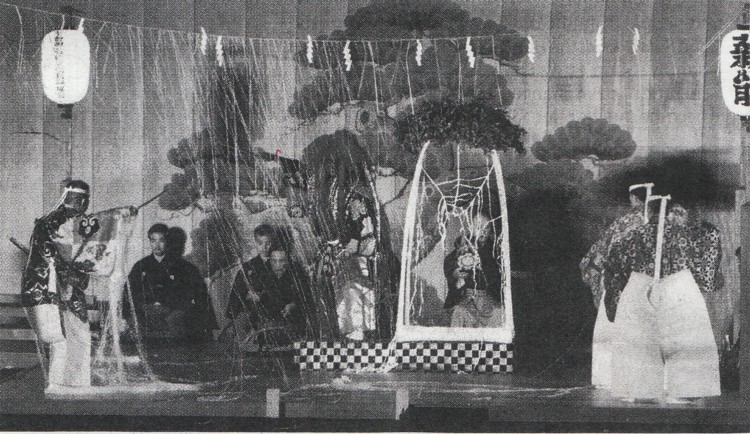


Actors perform noh at the Tokyo Citizen's Plaza 
in front of the Tokyo Metropolitan Government Building
in Shinjuku Ward, Sept.23.

IFAC 

 Nogaku is a musical drama where only male actors perform. They portray various actors including masked ghosts and goblins on top of the regular male and female roles.


 Also, the Noh was added to the representative List of the Intangible Cultural Heritage of Humanity designated by UNESCO.


 For non-Japanese speakers to understand and fully immerse themselves in the performance, simultaneous interpretation into English was offered throughout the event. The pamphlet, printed in both Japanese and English, were handed out to the 4,177 people who gathered to watch the classical Japanese theatrical art.


 The event was livestreamed on YouTube as well.


  IFAC Chairman Dr.Haruhisa Handa said in the opening remarks, “I was glad to be back to the Tokyo Citizen’s Plaza, a perfect venue to experience noh, to restart and continue the tradition of the event.”  


(source: THE JAPAN TIMES, October 6, 2018


Sunday, September 30, 2018

The 45th anniversary; Bruce Lee (2)


  TAF and Misuzu also hosted “Bruce Lee Festival Eve”, with Yuen to honor Lee, at the Kichijoji Dai Ichi Hotel, Tokyo, on July 29.
  In Lee’s unfinished film “Game of Death”, Yuen was chosen to play Lee’s double. Yuen said that he had intended to establish his own style while incorporating Lee’s way of performance.


Action Star Yuen Biao (left) and Bruce Lee impersonator Ryuhei Imai
give a demonstration as Dr.Handa looks on
in Tokyo on July 29.

TAF


(source: THE JAPAN TIMES, August 10, 2018

The 45th anniversary; Bruce Lee(1)


  In commemoration of the 45th anniversary of the death of Bruce Lee, TAF also hosted actor Donnie Yen and action star Yuen Biao, who were both much inspired by Lee, in discussions about the legendary martial artist. The event was to celebrate the launching of sales for the Bruce Lee tourbillion watch to which Misuzu Corp., imported watch seller, holds exclusive Japanese sales right.
 TAF and Misuzu also hosted the “Bruce Lee Festival” with Donnie Yen to honor Lee, at the Hyatt Regency Tokyo on Aug.1. Dr.Handa and Yen talked about various topics, including Yen’s Hollywood and Hong Kong projects that include “Rogue One: A Star Wars Story”, Disney’s “Mulan” remake, and “Ip Man” series, where Yen plays Ip Man, a legendary martial artist who was Lee’s master in real life.

(source: THE JAPAN TIMES, August 10, 2018

Saturday, September 29, 2018

The opera “Yuzuru” (3)


 Soprano Hiroko Onuki played Tsu, an injured crane who is saved by the farmer Yohyo,  acted by tenor Naoki Tokorodani. Tsu transforms herself into a human secretly and becomes Yohyo’s wife. She weaves a beautiful cloth from her feathers for him.

Baritone Masanobu Shibayama played Sodo, a greedy villager. He persuades Yohyo to let Tsu weave more luxurious cloth in order to make a fortune. Tsu accepts Yohyo’s wish, on condition that Yohyo never visits her while she weaves.

 However, tempted by villagers peeping into Tsu’s weaving place, Yohyo also goes to look, and he finds there a crane. Tsu, knowing Yohyo breaks his promise, leaves him and tranforms back into a crane.   

The opera “Yuzuru”(2)


 Based on the Japanese folktale “The Grateful Crane”, “Yuzuru” is Japan’s most renowned opera which has been performed more than 800 times in and outside of Japan since its first performance in 1952.

 During his speech, Dr.Handa recommended that the audience enjoy soloist’s voices, as well as to take note of how they are able to project their voices to the back of the theater.

During the performance, the singers did not use microphones.

 Dr.Handa said, “Today’s cast represents the finest singers, with expressive voices that have performed ‘Yuzuru’ many times.”


(source: THE JAPAN TIMES, August 10, 2018